
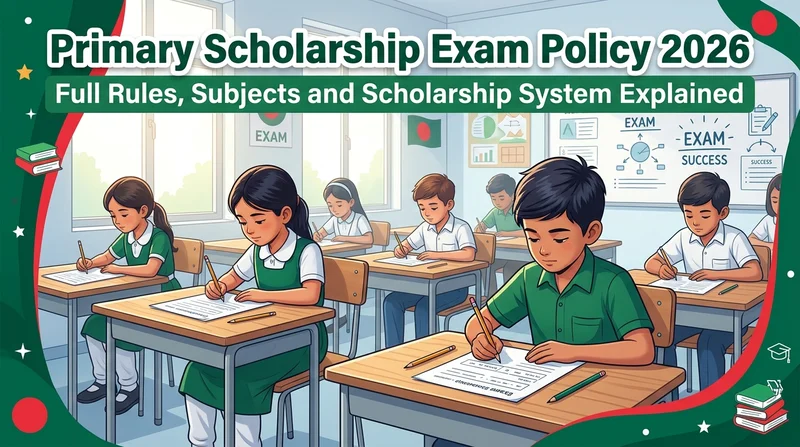
The government of Bangladesh has introduced the Primary Scholarship Exam Policy 2026. This policy explains how the scholarship exam will be organized for primary school students. It also describes the exam subjects, marks distribution, scholarship types, and rules for participation.
Primary education plays a very important role in building a strong nation. It develops children’s knowledge, skills, and values from an early stage. The government wants to ensure quality education for every child in the country.
The primary scholarship exam helps measure students’ academic ability. It also encourages schools to maintain better educational standards. Students who perform well in the exam receive scholarships based on their merit.
Background of the Primary Scholarship Exam
Primary education in Bangladesh is free and compulsory. The constitution ensures that every child gets equal access to education. Over time, the primary education curriculum has improved and become more modern.
Students now study several subjects including Bangla, English, Mathematics, Bangladesh and Global Studies, Primary Science, and Religious and Moral Education. These subjects help children become responsible citizens and prepare them for the future.
The scholarship exam allows fifth grade students to show their learning ability. Based on their results, the government awards two types of scholarships: Talentpool and General scholarships.
The system also ensures fairness. Boys and girls get equal opportunities. Students from both rural and urban areas can compete equally in the scholarship exam.
Name and Definition of the Policy
This policy is officially called the Primary Scholarship Exam Policy 2026. All activities related to the primary scholarship exam will follow this policy.
The scholarship exam will involve students from both government and approved private primary schools. It also includes registered kindergarten schools, community schools, NGO schools, and some special educational institutions.
Main Goal of the Scholarship Program
The main goal of the scholarship program is to recognize student talent. It also motivates schools to improve their teaching quality and academic performance.
Through this system, students receive recognition for their achievements. At the same time, schools get encouragement to provide better education.
Objectives of the Primary Scholarship Exam
- Recognize talented students at the primary level.
- Encourage students to develop their academic skills.
- Promote quality education in primary schools.
- Support students with scholarships based on merit.
Who Can Participate in the Scholarship Exam?
Students studying in class five can participate in the primary scholarship exam. However, not all students can take part. Schools will select students based on their academic performance.
Up to 40 percent of students from each school can participate in the exam. Schools will choose these students based on their cumulative assessment results from class four.
If multiple students have the same marks, the school will give priority based on marks in specific subjects. Bangla, Mathematics, English, Bangladesh and Global Studies, and Primary Science will be considered in that order.
All government primary schools must participate in the scholarship exam. Private schools can participate if they follow the national curriculum and are registered in the official education system.
Scholarship Exam Subjects, Marks and Time
The primary scholarship exam includes four subjects. Each subject carries equal marks. Students must complete each exam within the given time.
- Bangla – 100 marks – 2 hours 30 minutes
- English – 100 marks – 2 hours 30 minutes
- Primary Mathematics – 100 marks – 2 hours 30 minutes
- Bangladesh and Global Studies (50) + Primary Science (50) – 100 marks – 2 hours 30 minutes
Students with special needs will receive an additional 30 minutes for the exam.
The exam questions will follow the textbooks published by the National Curriculum and Textbook Board (NCTB).
To qualify for a scholarship, a student must score at least 40 percent marks in each subject.
Types of Primary Scholarships
The scholarship program provides two types of scholarships for students.
- Talentpool Scholarship
- General Scholarship
Both scholarships maintain gender balance. Half of the scholarships go to boys and the other half go to girls. If enough qualified students are not available in one group, the remaining scholarships can be filled by the other group.
Talentpool Scholarship System
Talentpool scholarships are distributed based on the highest marks obtained by students in each upazila or thana. Students with the best results receive these scholarships according to merit ranking.
In general, 80 percent of Talentpool scholarships go to government school students and 20 percent go to private school students. However, the national steering committee can adjust this ratio if necessary.
General Scholarship System
General scholarships are distributed across different unions, wards, and municipalities within each upazila or thana. Each union or ward usually receives five scholarships.
- Two scholarships for boys
- Two scholarships for girls
- One merit-based scholarship
If a ward does not have enough qualified students, the scholarship can be transferred to another eligible student within the same area.
What Happens if Students Get the Same Marks?
Sometimes two or more students receive the same total marks. In that case, the authorities will compare subject marks to determine priority.
The order of priority is:
- Bangla
- Mathematics
- English
- Bangladesh and Global Studies
- Primary Science
If students still have the same marks in all subjects, all of them may receive the scholarship.
Scholarship Exam Fee
Students must pay an exam fee to participate in the scholarship exam. The national steering committee determines the fee amount.
The Upazila or Thana Primary Education Office collects the fee. The collected money is deposited in the government treasury.
Full Notice PDF Download: https://jumpshare.com/share/IhmO55SAreFfgf72pEKV
Committees Responsible for the Scholarship Exam
Several committees manage and supervise the scholarship exam process. These include national, district, and upazila-level committees.
The national steering committee sets the exam schedule, determines the scholarship distribution, and provides overall policy guidance.
The executive committee manages operational tasks. These tasks include preparing question papers, printing answer sheets, distributing exam materials, and publishing the final results.
District and upazila committees coordinate local exam arrangements. They select exam centers, supervise the exam process, and ensure security during the exam.
Final Words
The Primary Scholarship Exam Policy 2026 introduces a structured system to evaluate students’ academic abilities. It encourages healthy competition among students and motivates schools to improve their education quality.
Through this scholarship program, talented students receive recognition and support at an early stage of their education. This initiative also helps build a stronger education system in Bangladesh.
For detailed instructions and official updates about the scholarship exam, students and parents should follow the official notice released by the education authorities.
Posted on: March 9, 2026
Categories: News